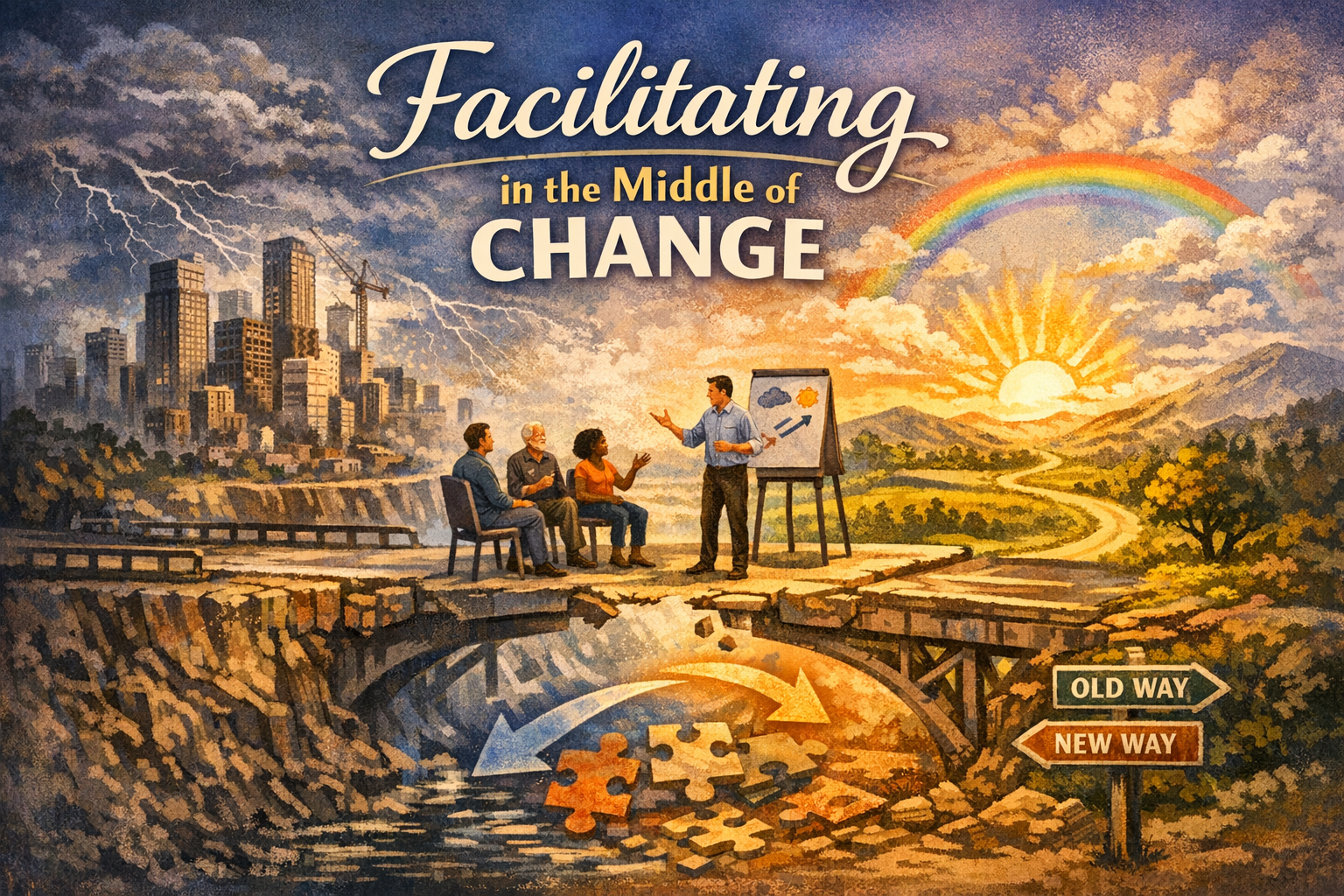
Lately, I’ve noticed that many of the rooms I’m in feel different. Not louder or more chaotic. If anything, they’re quieter. People are thoughtful, cautious, and often holding more than they say.
Change is everywhere: new tools, shifting expectations, growing attention on AI, and ongoing pressure to deliver while things are still in motion. In this environment, facilitation has taken on a slightly different shape.
Structure still matters. Clear purpose, good pacing, and thoughtful session design are as important as ever. But what seems to matter most right now is the quality of the space we create.
Many people are arriving with uncertainty about what’s changing, what’s not, and what it all means for them. As a facilitator, I’m finding that my role is less about pushing the group forward and more about holding steady.
Psychological safety can sound like a big concept, but in practice it shows up in very small ways.
Good facilitation doesn’t remove uncertainty. It makes it easier to sit with it together.
In more stable times, facilitation often focused on efficiency. Right now, many groups need time to make sense of what’s happening before moving to action.
That can mean slower pacing, fewer activities, and being comfortable with partial clarity. It often leads to stronger alignment later.
Change isn’t slowing down. What remains constant is the human need to feel heard, involved, and able to make sense of what’s happening.
Facilitation, done well, supports that. It helps people think together, not just move together.
If you would like support designing online sessions that make space for thinking - not just talking - you are welcome to get in touch.

Let's Connect, Create and Collaborate, together.
